
Pruning
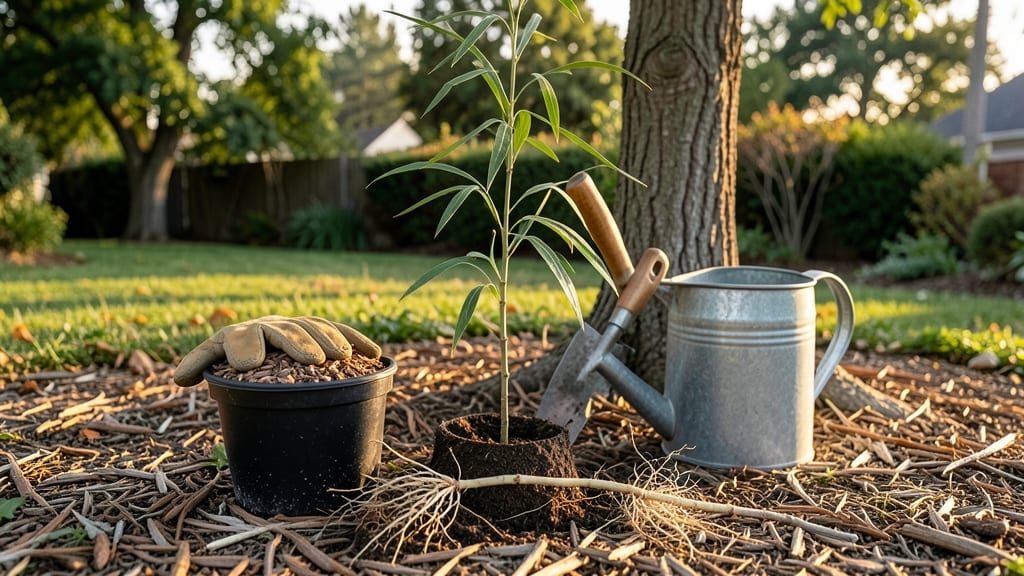
Planting willow tree starts in early spring or fall yields the fastest root growth, using fresh cuttings with 3-4 submerged nodes in moist, well-draining soil. Maintain consistent moisture and partial shade to prevent rot while promoting vigorous development.
Willow trees are famous for their rapid growth, and this starts with proper planting techniques.
The key lies in timing—spring and fall provide ideal temperature ranges for root establishment, while avoiding summer's heat stress or winter's dormancy challenges. 🌱 Fresh cuttings with multiple nodes encourage hormonal activity that triggers root formation, and keeping the soil consistently moist (but not soggy) mimics their natural wetland preferences.
Partial shade protects young shoots while allowing enough light for photosynthesis to fuel growth.
What many gardeners overlook is the soil's role—willows hate sitting in standing water, so amending clay or compacted soil with organic matter improves drainage while retaining moisture.
I've seen willow cuttings root in as little as two weeks under perfect conditions, but patience pays off when you give them the right environment to thrive.
💡 In This Article
- Optimal Conditions for Willow Tree Root Development
- Step-by-Step Guide to Planting Willow Tree Cuttings
Optimal conditions for willow tree root development
The rapid rooting of willow tree cuttings begins with understanding their natural growth hormones. When you take a cutting with 3-4 nodes (the small bumps where leaves attach), these nodes contain high concentrations of auxins—plant hormones that stimulate root formation.
Under ideal conditions, these auxins trigger cell division in the cambium layer (the growth tissue between bark and wood), leading to root initials within 7-14 days. The process accelerates in 50-65°F temperatures, which is why spring and fall planting align perfectly with willow biology. 🌱
Moisture plays a dual role in this process. Willow roots need consistent hydration to transport nutrients, but too much water causes anaerobic conditions that suffocate roots. The sweet spot is 60-70% soil moisture—enough to keep the cutting hydrated but with proper drainage to prevent rot.
Think of it like a sponge: willows thrive when their "sponge" is damp but not dripping. Partial shade (around 30-50% sunlight) protects the cutting from desiccation while allowing enough light for photosynthesis to fuel root growth. This balance mimics their native wetland habitats where they grow near water's edge.
Light levels directly impact photosynthesis rates in the leaves of your cutting. While willows can tolerate shade, 4-6 hours of morning sun provides enough energy for root development without causing stress. The leaves act as tiny solar panels, converting light into sugars that feed the growing roots.
What's fascinating is how willow cuttings can actually root in water (a technique called "water propagation"), but this method produces weaker root systems compared to soil propagation. The soil provides better oxygen exchange and microbial activity that boosts root vigor. 💧
Soil composition matters just as much as moisture levels. Willow trees prefer loamy soils with 10-20% organic matter that improves water retention without compacting. If your soil is heavy clay, amend it with 2-3 inches of compost or sand to create pockets for root expansion.
The ideal pH range is 6.0-7.5, which allows nutrients to be readily available. I've noticed that willow cuttings planted in pure sand root poorly because the lack of organic matter limits microbial activity that supports root growth.
The right soil mix acts like a growth accelerator for those critical first weeks.
Temperature fluctuations create another layer of complexity. Willow cuttings planted in late spring may face heat stress if temperatures exceed 80°F, while those planted in early fall benefit from cooler nights that slow water evaporation.
The 10°F temperature drop between day and night actually triggers hormonal changes that prepare the cutting for winter dormancy and stronger root establishment. This is why fall-planted willows often outperform summer plantings—they get a head start on root development before winter sets in. 🌿
One often-overlooked factor is the cutting's age and condition. Fresh cuttings taken in late winter or early spring have higher auxin levels than older wood. When selecting your willow branches, look for 1/4 to 1/2 inch diameter stems with smooth bark—these indicate healthy, vigorous growth.
The younger the wood, the faster it will root. I've experimented with willow cuttings from different seasons and found that those taken in March-April root in half the time of those taken in late summer, when the plant's energy is focused on leaf production rather than root growth.