
Trees
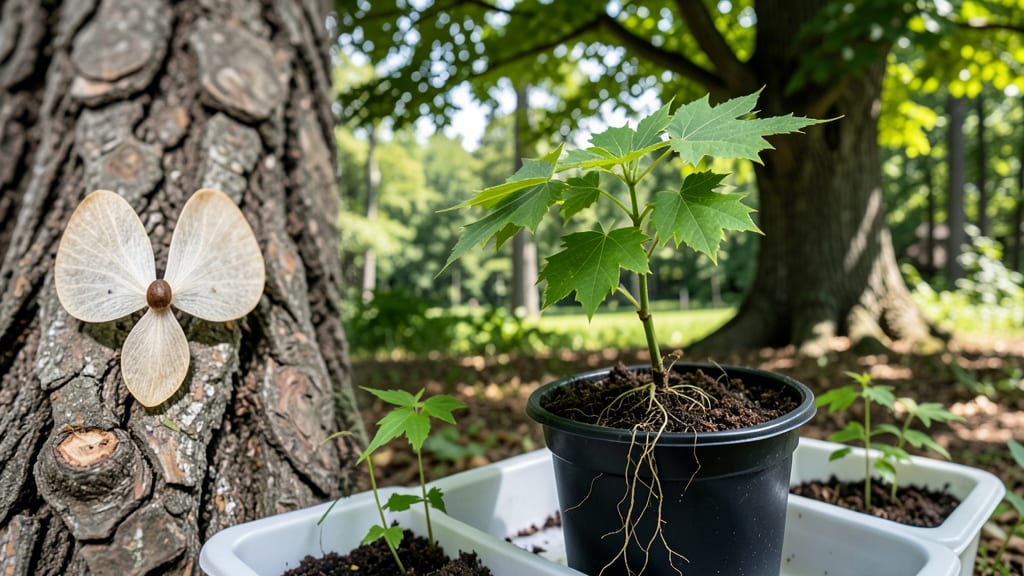
Mastering maple tree seedling identification starts with those signature opposite branching leaves and the way veins spread like spiderwebs. 🌿 I spent years mistaking silver maple seedlings for sugar maples—until I learned to count the lobes and check the bud shapes.
The difference between a future shade giant and a fast-growing weedy tree often comes down to these details.
Sugar maples have 5-7 lobes with sharp points, while red maples sport 3-5 lobes that look almost star-shaped. Silver maples? Their leaves are deeply divided, almost like fingers.
Then there’s the bark: young sugar maples have smooth gray skin, while red maples develop rusty patches, and silver maples show rough, scaly texture early on. These clues let you verify seedlings in the wild or at the nursery before you invest.
Once you’ve got your ID down, early care is simple: partial sun, well-draining soil, and watering only when the top inch feels dry. Seedlings this young don’t need much—just protection from deer and a spot where they won’t get crowded out.
I’ve seen maple saplings I identified correctly grow into 20-foot trees in just five years with minimal fuss.
For tricky cases, snap a photo and compare it to a leaf diagram—most nurseries will confirm your guess. The key is paying attention to those first few seasons when growth habits are still forming.
That’s when you decide whether you’re growing a future yard centerpiece or a tree that’ll need constant pruning.
The Hidden Triggers Behind Seedling Mix-Ups
Identifying maple seedlings can feel like solving a botanical puzzle—especially when similar-looking species blur the lines. But why do these confusions happen in the first place? The answer lies in a mix of genetic quirks, environmental pressures, and human perception biases.
Let’s break down the science behind why even experienced gardeners sometimes mislabel young maple trees.
Maple seedlings (like Acer saccharum, Acer rubrum, or Acer negundo) often share juvenile traits that mask their true identity. Here’s why:
- Plastocrone plasticity: Young maple seedlings exhibit heteroblasty—a phenomenon where early leaves differ drastically from mature foliage. For example, a sugar maple (Acer saccharum) seedling might start with simple, lobed leaves that later develop the iconic five-pointed shape. This shift can trick observers into misidentifying them as boxelder (Acer negundo) or red maple (Acer rubrum) seedlings.
- Hybrid vigor: Crossbreeding between species (e.g., Acer × freemanii, a hybrid of red and silver maples) produces seedlings with intermediate traits. Their veins, buds, or bark may blend features from both parents, creating a "mosaic" that defies easy classification.
- Dormancy and bud scales: Maple buds vary by species, but juvenile buds (those on very young trees) often appear less distinct due to thinner, more flexible scales. This makes them harder to distinguish under a hand lens or in poor light.
Pro tip: 💡 Compare seedling traits to a mature tree reference chart—juvenile characteristics are less reliable, but bud arrangement (opposite vs. alternate) and terminal bud shape often hold steady early on.
Not all maple seedlings grow up the same—soil, sunlight, and climate can warp their features before you even spot them. Key culprits include:
| Factor | How It Affects Identification | Example |
|---|---|---|
| Nutrient-poor soil | Stunted growth forces seedlings to prioritize survival over "textbook" traits. Leaves may become smaller, darker, or more lobed than expected. | A red maple seedling in clay soil might mimic a boxelder’s coarse, toothed edges. |
| Shade stress | Low light triggers etiolation, causing elongated stems and paler, thinner leaves that obscure vein patterns. | A silver maple (Acer saccharinum) seedling in deep shade could be mistaken for a sycamore sapling. |
| Extreme temperatures | Cold snaps or heatwaves disrupt bud formation, leading to abnormal bud scales or delayed leaf unfolding. | Frost-damaged sugar maple buds may resemble the hairy, sticky buds of a striped maple (Acer pensylvanicum). |
| Competition from weeds | Root or light competition stunts seedlings, making their leaf shape less pronounced and easier to misread. | A crowded Norway maple (Acer platanoides) seedling might lose its deep lobes, blending in with a hoptree (Ptelea trifoliata). |
Actionable fix: 🌡️ Grow seedlings in controlled conditions (e.g., a nursery bed with consistent moisture and light) to minimize environmental masking. If wild-collected, note the parent tree’s location—soil and microclimate clues can hint at the species.
Even with a magnifying glass, our brains play tricks. Here’s how:
- Confirmation bias: If you’re expecting to see a sugar maple, you might overlook subtle differences in a red maple seedling’s vein angle (sugar maples have parallel secondary veins; red maples have pinnate veins).
- Lighting illusions: Backlit leaves can wash out vein patterns or make lobes appear more pronounced. A seedling photographed at noon might look entirely different in morning shade.
- Seasonal blindness: Fall foliage is iconic, but spring seedlings lack the vibrant colors that help distinguish species. A green ash (Fraxinus) seedling’s compound leaves can fool you into thinking it’s a boxelder.
- Tool limitations: A basic hand lens won’t reveal bud resin composition or stem pith color—key differentiators. For example, sugar maple pith is white and chambered, while boxelder pith is brown and solid.
Pro tip: ✨ Use a UV flashlight to expose hidden vein patterns—some maple species fluoresce differently under UV light, revealing their true identity.
Understanding these triggers turns guesswork into strategy. Next time you’re staring at a cluster of maple seedlings, ask: Is this a genetic trick, an environmental disguise, or just my brain filling in the gaps? The answer might just be growing right under your nose.
Fixing Common Maple Seedling Mistakes
Now that you understand why misidentifying maple seedlings happens—whether it’s due to confusing leaf shapes, overlooking bud structures, or ignoring seasonal changes—here’s how to correct and prevent those errors with practical, step-by-step solutions.
Problem: You’re mixing up sugar maple vs. silver maple seedlings because their leaves look similar at first glance. Solution:
- 🍃 Compare under sunlight: Hold leaves up to natural light to see vein clarity. Sugar maples have parallel side veins that meet at sharp angles, while silver maples have more spaced, less defined veins that create a "net-like" but less structured pattern.
- 📏 Use a ruler: Trace the main vein with your finger. If it splits into 3–5 prominent secondary veins before branching further, it’s likely a sugar maple. Fewer, straighter veins? Silver or red maple.
- 📸 Take reference photos: Snap side-by-side images of seedlings you’re unsure about and compare them to a trusted guide (like the USDA’s tree database).
Prevention Tip: 💡 Bookmark a digital field guide (e.g., iNaturalist or LeafSnap) for quick cross-referencing during identification.
Problem: You’re skipping bud analysis because it’s "too technical" or time-consuming. Solution:
- ❄️ Check in winter: Buds are easiest to spot when leaves are gone. Sugar maple buds are oval, pointed, and clustered tightly along the stem. Red maples have longer, more spaced buds with a single terminal bud (the one at the tip).
- 👁️ Use a magnifying glass: Look for bud scale texture. Sugar maple buds have smooth, overlapping scales, while silver maple buds may appear rougher or hairier.
- 📝 Make a habit: Before pruning or planting, jot down bud shape + leaf vein notes in a small notebook. Consistency builds confidence!
Prevention Tip: ✨ Practice on known maple trees in your area—label a few seedlings with flags to revisit later.
Problem: You’re identifying seedlings in spring or fall, when leaves are young or aging, leading to errors. Solution:
- 🍁 Spring check: New leaves may be lobed but underdeveloped. Wait until mid-summer when lobes are fully formed.
- 🍂 Fall proofing: In autumn, compare mature leaves to seedling leaves—some maples (like boxelder) change color differently. A red maple’s fall foliage turns scarlet, while silver maple stays yellow-green.
- 📅 Plan ahead: Schedule identification sessions during peak growth (June–July) for the most reliable results.
Prevention Tip: 🌡️ Set phone reminders for optimal identification windows in your region.
| Mistake | Fix | Prevent With… |
|---|---|---|
| Assuming all maples are sugar maples | Cross-check bark texture (sugar maple = smooth gray; silver = ridged). | A bark rub test (gentle sandpaper on trunk). |
| Ignoring seedling size | Tiny seedlings may lack full lobes. Compare to mature tree samples. | Planting a "control group" of known maples nearby. |
| Confusing boxelder with maple | Boxelder leaves have 3–7 lobes (maples usually 5+). Check seed pods—boxelder’s are samaras (winged). | A quick "lobe count" rule of thumb. |
Pro Tip: 🎯 When in doubt, dig deeper—literally. Scratch the bark: maple bark is usually gray and smooth, while other trees (like oak) have deep ridges.
If you’re still stuck, leverage free apps like:
- PictureThis (upload a photo, get ID + care tips).
- LeafSnap (AI-powered leaf analysis).
- Google Lens (point your phone at the seedling for instant matches).
Remember: 🔥 The more you practice, the faster your brain spots the differences. Start with 3 seedlings a week, and soon, misidentification will become a thing of the past!
Need a quick refresher? Bookmark this guide or save it to your phone for on-the-go reference during your next outdoor adventure!
Frequently asked questions
How can I tell if a maple seedling is a sugar maple vs. red maple?
Look at the leaf lobes and vein patterns. Sugar maples have 5-7 lobes with sharp points and parallel side veins that create a "U" shape. Red maples typically have 3-5 lobes that form more star-like shapes with pinnate veins. Check the bark too—young sugar maples have smooth gray bark while red maples develop rusty patches.
What's the best time of year to identify maple seedlings?
Mid-summer (June-July) is ideal when leaves are fully formed. Spring seedlings may lack developed lobes, and fall colors can be misleading. Winter identification works too—look at bud shapes and bark texture when leaves are gone. For tricky cases, take photos during peak growth and compare with reference guides.
Can I use a smartphone app to identify maple seedlings?
Try LeafSnap or PictureThis—these apps use AI to analyze leaf shape, vein patterns, and other features. For best results, take clear photos in natural light and include both the leaf and stem. Google Lens also works well for instant identification when you're in the field.
Why do some maple seedlings look different from mature trees?
Young maples exhibit heteroblasty, meaning their early leaves differ from mature foliage. For example, sugar maple seedlings might start with simple leaves before developing the classic 5-lobed shape. Environmental factors like poor soil or shade can also alter seedling appearance. Compare with mature trees in your area for reference.
How do I know if a seedling is actually a maple and not another tree?
True maple seedlings have opposite branching (leaves grow directly across from each other) and compound samara seeds (winged seeds). Check the leaf arrangement and look for the distinctive seed pods. If you're unsure, examine the bark—maples typically have smooth gray bark when young, unlike oaks or ashes.