
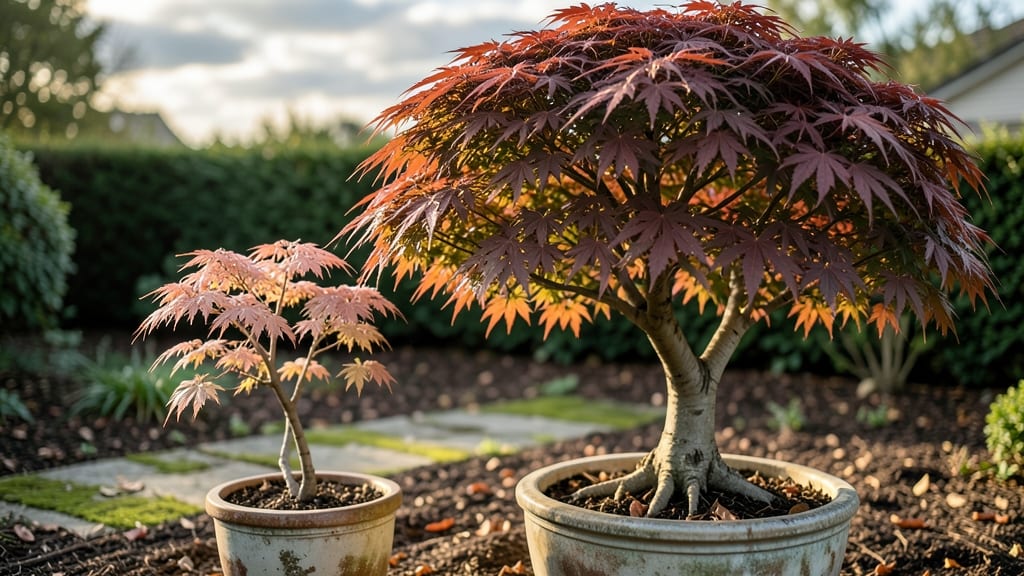
How Tall Japanese Maple Trees Grow: Variety-Specific Heights & Growth Habits

How To

How Tall Japanese Maple Trees Grow: Variety-Specific Heights & Growth Habits

A Japanese maple tree can grow how tall it does depends on the variety and care you provide—ranging from 10 feet to towering 30 feet at maturity 🌿.

If you're dreaming of a stunning Japanese maple tree but wondering whether it will dwarf your backyard or gracefully fit into a small garden, the answer depends entirely on the variety—some stay compact while others soar like skyscrapers.

Dwarf varieties like 'Bloodgood' or 'Emperor I' max out around 8-12 feet, making them perfect for patios or small yards, while standard types such as 'Shishigashira' or 'Shishigashira Katsura' can reach 20-30 feet in ideal conditions.

Below, I’ll break down the height ranges by variety, the factors that influence growth, and how to control size through pruning and care—so you can choose the perfect fit for your space.

Dwarf
8-12 ft
Container friendly
Semi-Dwarf
12-18 ft
Most popular
Standard
20-30 ft
Full orchard size

Japanese maple tree height by variety: compact to towering options

Japanese maple trees (Acer palmatum) are famous for their stunning foliage and graceful forms, but their mature height can vary dramatically depending on the variety.

If you're planning your landscape, knowing whether a particular cultivar will stay under 10 feet or reach towering heights over 30 feet is crucial. Some varieties are perfect for small gardens or container growing, while others need spacious yards or park settings to thrive.

Let's explore the full spectrum of heights you can expect from popular Japanese maple varieties.

When selecting a Japanese maple, consider not just height but also the spread and growth habit. Some varieties grow upright like a traditional tree, while others develop a low, spreading form.

The rootstock used during propagation also plays a role—grafted trees often grow more slowly and stay smaller than seed-grown varieties. Always check the specific cultivar's details, as even within the same species, heights can differ by 10 feet or more.

Here's a visual comparison of 12 popular Japanese maple varieties, organized from the most compact to the tallest. Each entry includes mature height, spread, and ideal spacing requirements to help you visualize how these trees will fit into your landscape.

For reference, a standard basketball hoop is 10 feet tall, while a three-story building is roughly 30 feet—this gives you a sense of scale for planning.

Factors that determine how tall your Japanese maple will grow

Japanese maple trees (Acer palmatum) are famous for their stunning foliage and graceful forms, but their mature height can vary dramatically—even within the same variety.

If you’ve ever wondered why your neighbor’s Bloodgood Japanese maple stands at 20 feet while yours maxes out at 12 feet, the answer lies in these key factors. Understanding them helps you predict growth and shape your tree’s future height with confidence.

The first major influence is rootstock type. Seed-grown Japanese maples (those grown from seed) tend to grow 20-30% taller than grafted varieties because they develop their own root systems. Grafted trees, on the other hand, are often bred for compact growth and may stay shorter.

For example, a grafted Dwarf Purple Dragon might reach just 8 feet, while a seed-grown version could soar to 15 feet or more.

🌿 Key Factors Affecting Japanese Maple Height

  • Rootstock: Grafted = shorter; seed-grown = taller
  • Pruning: Heavy pruning = bushier, slower vertical growth
  • Climate: Warmer zones = faster growth; cooler zones = slower
  • Soil: Well-draining, rich soil = optimal growth; poor soil = stunted

💡 Pro Tip: Measure your tree’s growth annually to adjust care for your desired height.

Your local climate zone plays a surprising role too. Japanese maples thrive in USDA Zones 5-8, but growth rates differ by region. Trees in Zone 7 or warmer often grow 1-2 feet faster per year than those in cooler Zone 5 areas.

For instance, a Green Cascade might reach 15 feet in 10 years in California but only 10 feet in the same time in upstate New York. Always check your zone to set realistic height expectations.

Don’t overlook soil conditions—they’re the foundation of your tree’s growth. Japanese maples prefer well-draining, slightly acidic soil (pH 6.1-7.5). Heavy clay or compacted soil can stunt root development, limiting height.

Amend your soil with organic matter like compost to encourage deeper roots and faster growth. A tree planted in ideal soil may grow 30% taller than one struggling in poor conditions.

Finally, pruning techniques can dramatically alter height. Pruning to encourage bushier growth (by cutting back central leaders) slows vertical expansion, while minimal pruning lets the tree grow taller naturally.

For example, if you prune a Shishigashira aggressively each year, it may stay under 6 feet, but with light pruning, it could reach 10 feet. Always prune in late winter or early spring to avoid stressing the tree.

By controlling these factors—rootstock, climate, soil, and pruning—you can steer your Japanese maple toward your ideal height. Whether you want a small accent tree for a patio or a towering specimen for your yard, understanding these variables gives you the power to shape your tree’s future.

Start with the right variety, nurture its roots, and prune with purpose for the perfect-sized tree. 🌳

★★★★★4.6(14 reviews)
Categories How To
Variety Mature Height (ft) Spread (ft) Growth Habit Ideal Spacing (ft)
'Taff's Fancy' 6-8 ft 6-8 ft Bushy, rounded 8-10 ft
'Bloodgood' 8-12 ft 10-15 ft Upright, vase-shaped 12-15 ft
'Emperor I' 8-12 ft 10-12 ft Low, spreading 10-12 ft
'Shishigashira' 10-15 ft 10-15 ft Upright, weeping 12-15 ft
'Crimson Queen' 12-15 ft 10-12 ft Upright, dense 15-18 ft
'Koto-no-ita' 12-18 ft 12-15 ft Low, spreading 15-18 ft
'Atropurpureum' 15-20 ft 15-20 ft Upright, pyramidal 20-25 ft
'Viridis' 15-25 ft 15-20 ft Upright, open 20-25 ft
'Dissectum' 15-25 ft 15-20 ft Weeping, cascading 20-25 ft
'Orange Dream' 20-25 ft 15-20 ft Upright, vase-shaped 25-30 ft
'Shishigashira' (seed-grown) 25-35 ft 20-30 ft Tall, spreading 30-40 ft