
Pruning
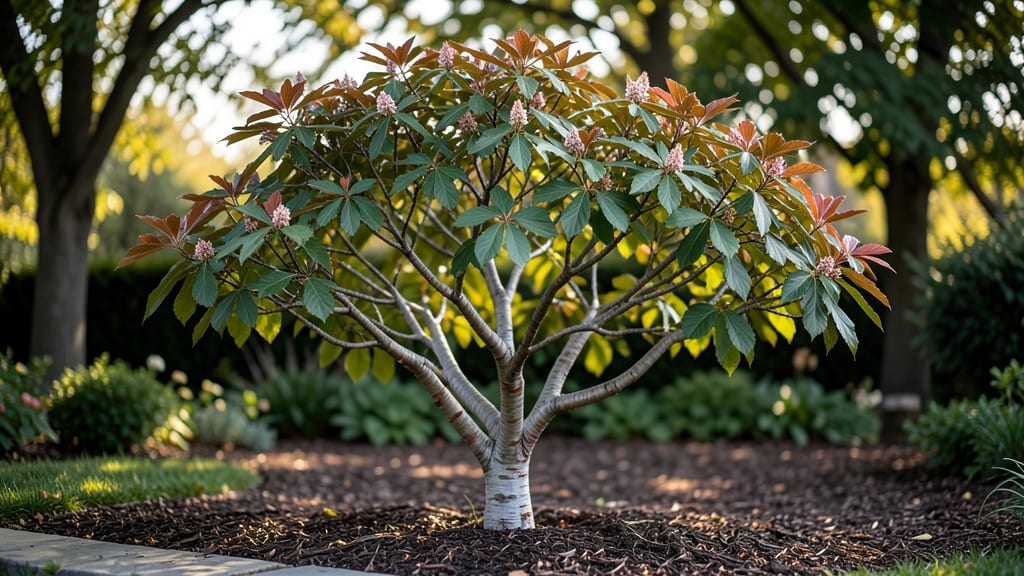
That five-pointed leaf isn't just pretty—it's a game-changer for your yard. 🌿 Whether it's a maple's classic silhouette or the unique compound leaves of Melia azedarach, these trees create dense, balanced canopies that shade, shelter, and wow neighbors.
I've shaped my own five-leafed beauty into a perfect dome, and the difference in airflow and sunlight distribution is night and day.
Start with the right spot: full sun to partial shade and well-draining soil that's slightly acidic. Most of these trees tolerate heat once established, but young ones need consistent moisture—think 1-2 inches per week during dry spells.
The secret to that lush, layered look? Prune strategically in late winter or early spring, cutting back 1/3 of the oldest branches to encourage new growth from the base.
By summer, you'll see the payoff: vibrant green foliage that stays put all season, plus those signature leaves that catch the light like stained glass. The canopy stays balanced naturally, reducing storm damage and creating that perfect dappled shade effect.
Even pests like aphids struggle to take hold when the tree's structure is this strong.
Works for urban yards, suburban lots, or even large containers if you're short on space. The key is patience—these trees grow 6-12 feet per year when happy, so every pruning session shapes the future of your shade. Let's get those branches in line!
Behind The Odd Leaf Shape
Understanding why some trees develop a five-point leaf (or pentafoliate leaves) instead of the typical three or seven points requires a dive into genetics, environmental stress, and developmental biology. While this trait isn’t always a cause for concern, it often signals underlying factors worth exploring. Here’s why it happens:
Some trees are born with five-point leaves due to natural genetic variations. Certain species, like the sugar maple (Acer saccharum) or horse chestnut (Aesculus hippocastanum), occasionally produce pentafoliate leaves as part of their standard variation.
These mutations can arise from: - Random genetic recombination during reproduction, where leaf structure genes (like those controlling leaflet number) recombine unpredictably. - Hybridization, where two parent trees with slightly different leaf structures produce offspring with unique traits (e.g., a cross between a maple and a boxelder). - Clonal propagation, where a single cutting or grafted branch retains a rare trait (like five points) across generations.
💡 Pro Tip: If your tree consistently produces five-point leaves and thrives without stress, it’s likely a natural genetic quirk—not a problem. Test this by observing nearby trees of the same species for similar traits.
Adverse growing conditions can trigger abnormal leaf development, including extra points. Common stressors include: - Nutrient deficiencies (e.g., magnesium or nitrogen shortages), which disrupt cell division in leaf primordia (the early leaf buds).
A lack of these nutrients forces the plant to "split" existing leaflets into smaller points for survival. - Waterlogging or drought, which stunts root growth and limits nutrient uptake.
Poor hydration causes meristematic cells (growth cells) to divide erratically, leading to irregular leaf shapes. - Extreme temperatures (frost damage or heatwaves) during leaf emergence. Young leaves are highly sensitive to temperature fluctuations, and sudden shifts can cause abscission layers to form prematurely, resulting in split or extra points.
🌡️ Watch For: If five-point leaves appear only on younger branches or after a harsh winter, environmental stress is the likely culprit. Conduct a soil test to check pH and nutrient levels.
Pathogens and insects can physically alter leaf development by: - Viruses (e.g., maple mosaic virus) that disrupt the plant’s phytohormone balance, causing stunted or malformed leaves.
These viruses often spread via sap-feeding insects like aphids. - Fungal infections (e.g., anthracnose or powdery mildew), which clog stomata (leaf pores) and force the tree to compensate by producing extra leaflets for photosynthesis. - Insect feeding (e.g., Japanese beetles or spider mites), which chew leaf edges, triggering the tree to regrow damaged areas as smaller, irregular points.
🔥 Act Now: Inspect leaves for yellowing, black spots, or webbing. Treat fungal issues with neem oil and viral pests with systemic insecticides (like imidacloprid).
Mechanical damage to the apical meristem (the tree’s growth tip) can force lateral buds to develop into leafy shoots with unusual shapes.
Causes include: - Pruning cuts too close to the bud, which severs the primary growth center and prompts side buds to sprout with altered structures. - Hail, wind, or animal damage (e.g., deer rubbing bark) that crushes meristem tissue, leading to compensatory growth. - Root disturbance (e.g., construction or transplant shock), which redirects energy to leaf production at the expense of normal morphology.
✨ Prevent It: Always prune above the bud (using the branch collar method) and avoid heavy-handed shaking or bending of young branches.
Hormones like auxin, gibberellins, and cytokinins regulate leaf shape.
Disruptions can occur due to: - Over-fertilization with high-nitrogen supplements, which spikes cytokinin levels and promotes excessive leaflet splitting. - Root-pruning or girdling, where the tree’s hormonal signals get scrambled, leading to erratic growth patterns. - Endogenous factors (internal plant signals) during flowering or fruiting, where the tree prioritizes reproductive structures over leaf uniformity.
📊 Test This: If five-point leaves appear only on fruiting branches, hormonal shifts during pollination are likely the cause. Balance fertilizer use with slow-release, organic options to avoid spikes.
Revitalizing Your Five-Leaf Wonder
If your tree with five-point leaves is struggling with uneven growth, sparse foliage, or a lopsided canopy, don’t worry—there’s hope! The key lies in targeted pruning, proper care, and a little strategic patience. Below, we break down the most common issues and actionable solutions to restore your tree’s health and shape. Whether you’re dealing with overgrowth, dead branches, or weak new shoots, these steps will help you nurse your tree back to its full, lush potential.
If your tree’s canopy is so thick that sunlight barely reaches the lower branches, it’s time to thin out the foliage. Dense growth can lead to fungal diseases, pest infestations, and weak branches.
🔪 Step-by-Step Thinning Guide
- Identify the Problem Areas
- Look for branches where leaves overlap excessively, blocking light.
- Focus on the interior of the canopy first—this is where stagnant air and moisture thrive.
- Choose the Right Tools
- Use bypass pruners for small branches (up to ½ inch thick).
- For thicker branches, grab a pruning saw with a fine-tooth blade to avoid tearing.
- Make Clean Cuts
- Cut just outside the branch collar (the swollen area where the branch meets the trunk).
- Angle your cut slightly away from the trunk to prevent water from pooling.
- Remove Up to 25% of the Foliage
- Never remove more than a quarter of the canopy in one session—this can shock the tree.
- Prioritize vertical branches growing straight up; these compete with the leader (main trunk) for dominance.
- Sanitize Your Tools
- Wipe blades with rubbing alcohol or a 10% bleach solution between cuts to prevent disease spread.
💡 Pro Tips for Thinning Success
- 🌡️ Time It Right: Prune during the dormant season (late winter/early spring) for best results.
- ✨ Avoid "Topping": Never just hack off the top of branches—this creates ugly stubs and encourages weak regrowth.
- 👨🌾 Monitor for Stress: If the tree drops excessive leaves after pruning, it may be reacting to stress.
Water deeply and avoid further cuts for a few weeks.
A single dead or infected branch can drain nutrients from your entire tree. If you spot brown, brittle leaves, black spots, or oozing sap, act fast to prevent the issue from spreading.
🔍 How to Identify a Problem Branch
| Sign | What It Means | Action Needed |
|---|---|---|
| Dry, crumbly leaves | Dead branch (no sap when cut) | Remove immediately |
| Fungal growth (mold) | Disease (e.g., anthracnose, powdery mildew) | Prune and treat with fungicide |
| Sawdust-like holes | Pest damage (borers, beetles) | Remove branch + treat soil for larvae |
| Wilting leaves | Root or vascular disease | Consult an arborist; may need systemic care |
🍳 Step-by-Step Removal
- Sterilize Your Tools – Use 70% isopropyl alcohol to kill pathogens.
- Cut at the Branch Collar – Never leave a stub; this invites decay.
- Dispose of Infected Material – Bag and trash diseased branches off-site to prevent reinfection.
- Seal Larger Wounds – For cuts over ½ inch, apply pruning sealant (optional for small trees; skip for large, mature ones).
🌟 Prevention Tips
- 💪 Strengthen Immunity: Feed your tree with balanced fertilizer (e.g., 10-10-10) in early spring.
- 🚫 Avoid Overwatering: Soggy soil invites fungal growth—water deeply but infrequently.
- 🐛 Pest Patrol: Inspect branches monthly for chewed leaves, sawdust-like frass, or tiny holes.
If your tree’s canopy is uneven—perhaps leaning too much in one direction or lacking lower branches—it needs structural pruning to encourage balanced growth.
🎯 Corrective Pruning Techniques
- 🔄 Reduce Dominant Branches
- If one side is too heavy, thin out branches there by up to 30% to redistribute energy.
- 🌿 Encourage Lower Branches
- Select 3-4 strong lateral branches near the base and trim competing vertical "water sprouts."
- Use a growth regulator (like paclobutrazol) if your tree naturally grows too tall.
- 🌳 Support the Leader (Main Trunk)
- If the central stem is weak, stake it temporarily (for young trees) to prevent bending.
- Avoid pruning the leader unless it’s dead or diseased.
✨ Long-Term Balance Tips
- 🌞 Light Exposure: Ensure the tree gets 6+ hours of sunlight daily—uneven light causes skewed growth.
- 🌱 Regular Maintenance: Prune annually in late winter to shape incrementally.
- 🌿 Mulch Properly: Use 2-3 inches of organic mulch (wood chips, bark) to retain moisture and nutrients evenly.
With these targeted fixes, your five-point leaf tree will regain its strength, symmetry, and vibrancy. Remember: patience is key—trees heal gradually, but consistent care pays off in lush, balanced foliage for years to come. 🌿✨
Frequently asked questions
What are the most common trees with five-pointed leaves?
Classic examples include maple trees (like sugar maple or silver maple), horse chestnut, and chinaberry (Melia azedarach). Some varieties of boxelder and sycamore also produce five-pointed leaves, though they're less common. The shape often makes these trees stand out in landscapes!
Can I grow a five-point leaf tree in a container?
Smaller varieties like dwarf maples or young chinaberry trees thrive in 15-20 gallon containers with well-draining soil. Use a mix of potting soil and perlite, and ensure the container has drainage holes. Rotate the pot every few weeks to prevent lopsided growth.
Why do some branches have five-point leaves while others don't?
This often happens due to genetic variation within the same tree or environmental stress. If younger branches show five points while older ones don't, it may indicate nutrient deficiencies (like magnesium) or hormonal imbalances. Test your soil and adjust fertilizer to 10-10-10 ratio for balanced growth.
How do I prevent my five-point leaf tree from getting too tall?
Prune the topmost branches (leader) by 1/3 in late winter to encourage bushier growth. For faster results, use a growth regulator like paclobutrazol during early spring. Avoid heavy pruning after June, as new growth won't harden before winter.
Are five-point leaves more susceptible to pests?
Not necessarily—the leaf shape itself doesn't increase vulnerability. However, dense foliage from five-point leaves can trap moisture, attracting aphids or spider mites. Monitor undersides regularly and spray with neem oil if you spot webbing or sticky residue (honeydew). Keep the canopy open with strategic pruning.