
Pruning
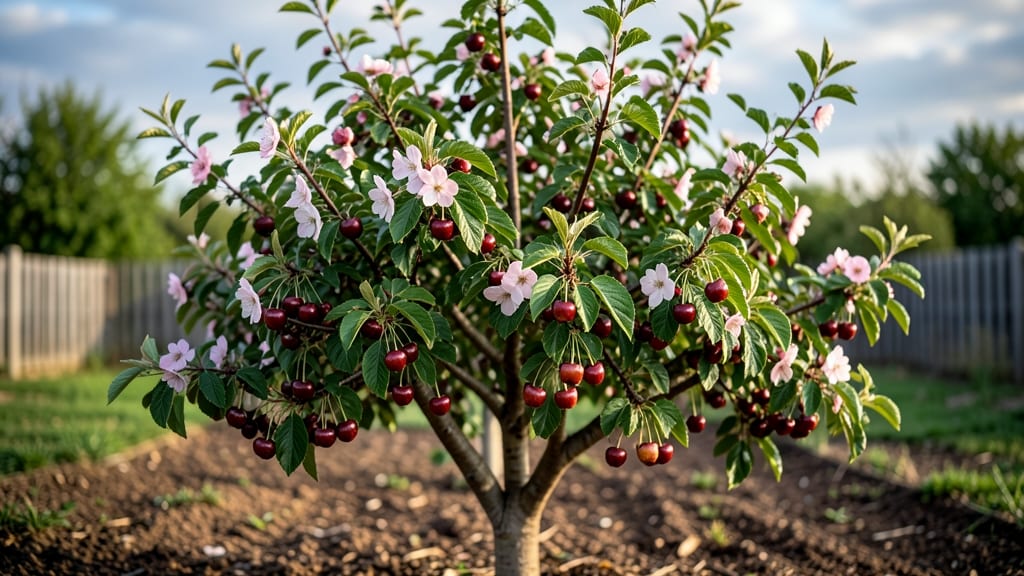
Rainier cherry trees are self-pollinating, meaning they produce fruit without needing another tree for cross-pollination. Their flowers contain both male and female parts, ensuring reliable yields when planted alone.
This unique trait makes Rainier cherries ideal for small gardens or urban spaces where planting multiple trees isn't practical. 🌸 The hermaphroditic flowers contain both pollen-producing stamens and pollen-receptive pistils, allowing fertilization to occur within the same blossom.
Unlike sweet cherries that require cross-pollination, Rainier trees consistently bear fruit when grown alone, though their yields can be enhanced with proper care and environmental conditions.
What sets Rainier cherries apart is their genetic stability—this self-pollinating characteristic has been bred into the variety specifically to eliminate the need for companion trees. The flowers' structure promotes efficient pollen transfer, either through wind or gentle insect activity, ensuring fruit development even in isolated plantings.
This makes them particularly appealing for home gardeners seeking reliable cherry production with minimal space requirements.
💡 In This Article
- How Rainier Cherry Trees Achieve Self-Pollination
- Maximizing Fruit Production in Self-Pollinating Rainier Cherries
How Rainier cherry trees achieve self-pollination
The Rainier cherry tree's self-pollinating ability stems from its unique flower structure, which contains both male and female reproductive organs in a single blossom. These hermaphroditic flowers eliminate the need for external pollen sources, a trait genetically bred into this specific variety.
The flowers' anatomy includes 5-7 stamens (male parts producing pollen) and a central pistil (female part) with a stigma that captures pollen. This dual functionality allows fertilization to occur when pollen from the stamens lands on the stigma of the same flower.
Pollen transfer happens primarily through wind and occasional insect activity, though Rainier cherries are far less dependent on pollinators than sweet cherry varieties. The flowers' open structure and positioning on the tree's branches facilitate this process - unlike some cherry varieties where flowers are tightly clustered.
During peak bloom (typically late April to early May in most growing zones), a single tree can produce enough pollen to fertilize its own flowers, resulting in fruit set rates of 70-90% when conditions are optimal.
This contrasts sharply with sweet cherries, which often require two different trees within 50 feet for successful cross-pollination.
The genetic stability behind this trait is particularly noteworthy. Rainier cherries were developed through careful selective breeding to maintain consistent self-pollination across generations. Their 60-70 chromosome pairs (compared to 16 in most fruit trees) contribute to this stability, creating a reliable fruit-bearing mechanism.
This genetic consistency means gardeners can expect consistent yields year after year without worrying about pollination failures. The trees' compact growth habit (typically 12-15 feet tall) further enhances their self-sufficiency by keeping flowers accessible to wind currents.
What makes this mechanism even more impressive is how it adapts to environmental conditions. Rainier cherry flowers have developed a two-phase opening system: they open partially in the morning to release pollen, then fully in the afternoon to receive it.
This timing maximizes both pollen dispersal and capture, increasing the chances of successful fertilization. The flowers also produce sticky pollen grains that adhere well to stigmas, even in light wind conditions.
This biological adaptation explains why Rainier cherries often outperform other varieties in urban environments where pollinator activity might be limited.
Comparing Rainier cherries to their non-self-pollinating counterparts reveals significant advantages. While sweet cherries require precise pollinator management (often involving bee hives or multiple tree varieties), Rainier cherries demonstrate remarkable independence.
Their yellow-red fruit coloration and sweet-tart flavor profile (with 16-18% sugar content) remain consistent because the breeding process focused on maintaining both pollination reliability and fruit quality.
This dual success makes them particularly valuable for commercial orchards in regions with limited pollinator populations or for home gardeners with space constraints.
One fascinating aspect of this self-pollination system is how it affects fruit development. After successful pollination, the flowers' ovaries develop into 1.5-2 inch diameter cherries with distinctive yellow-red skin. The tree's genetic programming ensures these fruits mature uniformly, typically reaching harvest readiness in 90-100 days after bloom.
This consistency in fruit set and development is a direct result of the stable self-pollination mechanism, which eliminates the variability often seen in cross-pollinated varieties where different genetic combinations can lead to uneven fruit quality.