
Plants
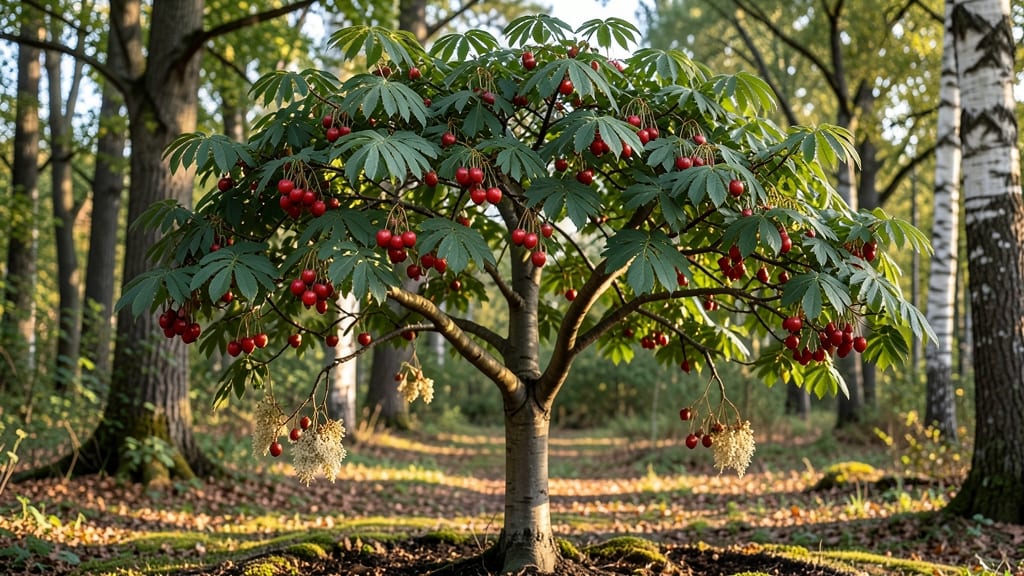
A rowan tree looks like a small, rounded deciduous tree with white spring blossoms, glossy dark green leaves, bright red-orange berries in clusters, and smooth gray bark that develops scaly ridges with age. Its elegant shape and colorful foliage make it a standout in gardens.
A rowan tree's most striking feature is its seasonal transformation. 🌸 In spring, delicate white blossoms appear before the glossy green leaves unfurl, creating a picturesque contrast.
Summer brings vibrant foliage, while autumn transforms the leaves into fiery reds and oranges—though the tree's real showstopper arrives in late summer when clusters of bright red-orange berries form, often persisting well into winter. This persistent fruit is a key identifier, as it remains even after the leaves have fallen.
The bark starts smooth and gray but gradually develops distinctive scaly ridges as the tree matures, giving it a textured, almost sculptural appearance. 🌿 Unlike similar trees, rowan's berries grow in dense clusters along the branches, while its leaves are more oval-shaped with serrated edges.
These unique characteristics help distinguish it from look-alikes like mountain ash or hawthorn, which have different berry arrangements and leaf shapes.
💡 In This Article
- Identifying Rowan Tree Features by Season
- How to Distinguish Rowan Trees from Similar Species
Identifying rowan tree features by season
The rowan tree's seasonal evolution begins with its spring blossoms, which emerge in late April to May as delicate, five-petaled white flowers with a subtle pinkish tint at their base.
These blossoms grow in clusters of 10-20 flowers per stem and have a faint, sweet fragrance that attracts pollinators like bees.
The flowers appear before the leaves, creating a striking contrast against the tree's bare branches. 🌸 This early bloom is a key identifier, as most similar trees bloom after leaf emergence.
By summer, the tree develops its signature glossy dark green leaves, which are 2-4 inches long with a slightly oval shape and finely serrated edges. The leaves grow on short stems and have a leathery texture when mature, feeling slightly waxy to the touch.
Unlike many trees, rowan leaves maintain their vibrant green color well into autumn, though they eventually transition to brilliant red-orange hues as temperatures drop. This delayed color change helps distinguish rowan from other trees that turn yellow or brown earlier.
The most iconic feature appears in late summer to early autumn when the tree produces its bright red-orange berries in dense clusters along the branches. These berries, called haws, are about ½ inch in diameter and contain a single seed surrounded by a tart, slightly astringent pulp.
What makes rowan unique is how these berries persist through winter, often remaining on the tree until spring, long after other trees have shed their fruit. 🍎 This persistence is a crucial field identification marker.
The tree's bark undergoes a dramatic transformation as it ages. Young rowan trees have smooth gray bark, but as they mature (typically after 10-15 years), the bark develops distinctive scaly ridges that create a textured, almost sculptural appearance.
These ridges become more pronounced with age, giving older specimens a rugged character that contrasts with their delicate flowers and berries. The bark's progression from smooth to ridged happens gradually, making it another seasonal identifier.
In winter, when most trees are bare, rowan trees stand out with their persistent berries and dark red branches. The berries provide a vital food source for birds like thrushes and waxwings, which help disperse the seeds.
This winter persistence is one reason rowan is often called the "mountain ash" in some regions, though it's not closely related to true ash trees. The tree's rounded canopy, typically reaching 15-25 feet in height, completes its seasonal transformation year-round.
What most people don't realize is how the rowan's berry clusters differ from similar trees. While mountain ash has berries arranged in flat-topped clusters, rowan's berries grow in dense, rounded clusters that resemble small pom-poms.
This difference, combined with the berries' persistence through winter, makes rowan easily identifiable even for novice tree spotters. 🌿 The tree's ability to maintain its visual interest across all seasons is what makes it a favorite in ornamental gardening.