
Advice
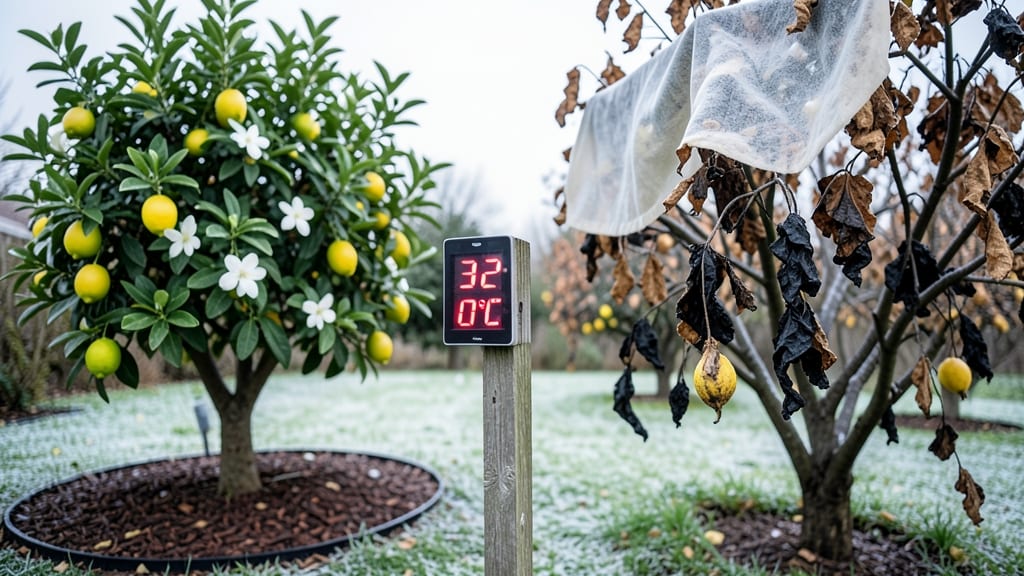
Can a lemon tree survive a freeze? Yes, but only if temperatures stay above 25°F (-4°C) for short periods—prolonged exposure below 20°F (-7°C) will likely kill the plant. Young trees are especially vulnerable, while mature ones may recover with proper protection like mulching or wrapping.
Lemon trees are tropical plants that thrive in USDA Zones 9-11, where winters rarely drop below freezing. 🌱 The real danger comes from extended cold snaps—even brief dips to 25°F can stress the tree, while sustained freezing temperatures destroy the delicate cell structure of leaves and branches.
I’ve seen mature trees survive a single night at 28°F with protection, but repeated exposure below 20°F is almost always fatal.
The key is acting fast: wrapping the trunk, covering the canopy with frost cloth, and insulating the root zone with mulch can make all the difference between recovery and loss.
What’s interesting is how lemon trees react differently based on their age. Young trees, still establishing roots, struggle more with cold stress because their systems aren’t as resilient.
Mature trees, on the other hand, have deeper root systems that can draw up moisture to protect against freeze damage—but even they need help when temperatures plummet. If you’re in a marginal zone, consider growing lemon trees in containers so you can move them indoors during winter.
💡 In This Article
- Lemon Tree Freeze Hardiness by USDA Zones
- Protecting Lemon Trees from Winter Freezes
Lemon tree freeze hardiness by USDA Zones
Lemon trees are tropical plants, and their ability to survive cold depends on how quickly temperatures drop and how long they stay below freezing. The science behind freeze damage lies in the plant's cell structure.
When temperatures fall below 28°F (-2°C), the water inside citrus leaves and stems begins to crystallize, rupturing cell walls. This process is called intracellular ice formation, and it’s irreversible once it starts.
Lemon trees in USDA Zones 9-11 (where winters rarely dip below 20°F (-7°C)) are naturally adapted to mild climates, but even a brief dip to 25°F (-4°C) can cause significant stress.
Prolonged cold is far more damaging than sudden temperature drops.
A single night at 28°F (-2°C) might only cause leaf burn, but sustained exposure below 20°F (-7°C) will kill the tree’s vascular system, preventing it from transporting water and nutrients. 🌱 In contrast, mature lemon trees in Zone 10 (like those in Southern California) can tolerate brief freezes down to 25°F (-4°C) if their roots are protected, but young trees in the same zone may suffer severe damage even at 30°F (-1°C).
This is because younger trees lack the deep root systems needed to store moisture and regulate temperature internally.
The critical threshold for lemon tree survival is 25°F (-4°C) for short durations—anything colder or longer increases the risk of permanent damage. For example, a lemon tree in Zone 8 (where winters can reach 10°F (-12°C)) will almost certainly die without protection.
However, in Zone 9, where winter lows might hit 22°F (-6°C) occasionally, the tree can survive if its roots are insulated with 4-6 inches of mulch and its trunk is wrapped to prevent moisture loss.
What’s fascinating is how lemon trees react differently based on their exposure history.
Trees grown in slightly cooler microclimates (like coastal areas with milder winters) develop some cold tolerance, but they’re still not as hardy as native citrus species like the Mexican lime, which can survive brief freezes down to 20°F (-7°C).
This is why grafted lemon trees (common in home gardens) often struggle more—their rootstock might be more cold-resistant, but the scion (the lemon variety itself) remains sensitive to cold stress.
If you’re growing a lemon tree in a marginal zone, consider its placement. Trees near heat-retaining structures (like brick walls) or in full sun during the day can experience 5-10°F warmer microclimates than open areas. This extra warmth can mean the difference between survival and death during a freeze.
For instance, a lemon tree in Zone 8b (where winters dip to 15°F (-9°C)) might survive a 2-day freeze at 22°F (-6°C) if planted against a south-facing wall, but it would likely perish in an unprotected location.
Understanding these nuances helps you prepare. For example, if you’re in Zone 9a (where winters can reach 20°F (-7°C)), you’ll need to act quickly when a freeze warning is issued.
Covering the tree with frost cloth and wrapping the trunk with bubble wrap can buy critical time, but the real key is protecting the roots—where most freeze damage originates.
A thick layer of straw or wood chips around the base can insulate the soil and keep it 5-10°F warmer than the air temperature.
Remember, even if your lemon tree survives a freeze, it may enter a state of dormancy or produce fewer fruits the following season. The cold stress weakens the plant, making it more susceptible to pests and diseases.
That’s why post-freeze care—like pruning damaged branches and fertilizing in spring—is just as important as the protection you provide during the cold months. 💫