
Plants
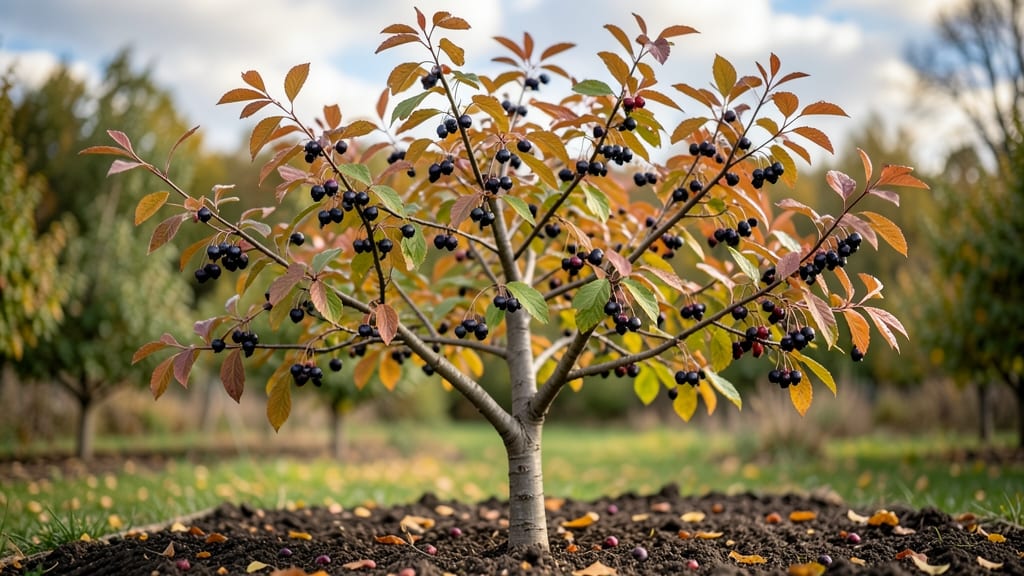
A chokeberry tree looks like a medium-sized shrub or small tree with glossy, oval-shaped leaves that have serrated edges, producing dark purple-black berries in dense clusters. Its smooth gray bark features horizontal lenticels, and it grows upright to 15-25 feet tall with a rounded canopy.
A chokeberry tree—also called aronia—stands out with its striking dark berries that stay on the branches well into winter, unlike many fruits that drop earlier. 🌿 The leaves turn vibrant red or purple in fall, creating a bold contrast against the gray bark.
I always recommend planting chokeberries near pathways or garden edges, where their compact size and colorful foliage make them eye-catching year-round. Their upright growth habit also makes them ideal for hedges or privacy screens.
What sets chokeberry apart visually is how its berries cluster densely along branches, resembling small grapes but with a deeper purple hue. The bark's horizontal lenticels (tiny raised lines) help distinguish it from similar trees like dogwood, which has smoother bark.
For best identification, compare the leaf shape—chokeberry leaves are oval with fine serrations, while hawthorn leaves often have more pronounced teeth.
💡 In This Article
- Identifying Chokeberry Tree Leaves, Berries, and Bark
- Chokeberry Tree Growth Habit and Best Planting Conditions
Identifying chokeberry tree leaves, berries, and bark
The chokeberry tree's leaves are one of its most distinctive features, with a glossy, deep green surface that reflects light beautifully. These oval-shaped leaves measure about 2-4 inches long and 1-2 inches wide, tapering to a point at the tip.
The serrated edges have fine, sharp teeth that create a saw-like appearance when viewed closely. In spring, new leaves emerge with a reddish tint before maturing to their signature green, while fall brings a stunning transformation into fiery red or purple hues.
What truly makes chokeberry trees stand out are their berries, which are dark purple-black and grow in dense, grape-like clusters along the branches. Each berry is roughly 0.25-0.5 inches in diameter, packed tightly together in bunches that can stretch up to 3-4 inches.
Unlike many fruits that drop in autumn, chokeberries often persist on the tree well into winter, providing visual interest even when bare.
The berries have a waxy coating that gives them a slightly shiny appearance, and their deep color comes from high anthocyanin content—similar to blueberries but with a more intense hue.
The bark of a chokeberry tree serves as another key identification marker, featuring a smooth, gray surface with distinctive horizontal lenticels. These tiny, raised lines run parallel to the branch, resembling small grooves or stripes.
As the tree matures, the bark develops a more textured appearance but retains its gray tones. This bark pattern helps differentiate chokeberry from similar trees like dogwood, which has smoother bark without lenticels, or hawthorn, whose bark often develops more pronounced ridges with age.
Seasonal changes provide additional clues for identification. In spring, chokeberry trees produce small, white flowers that bloom in clusters, creating a delicate contrast against the emerging foliage.
These flowers give way to the berries by late summer, while the fall foliage transition offers a dramatic visual shift from green to red or purple. This seasonal progression makes chokeberry trees particularly striking in landscape settings, where their changing appearance adds year-round interest.
When comparing chokeberry to similar species, pay attention to these key differences: hawthorn trees have more jagged leaf edges and thorny branches, while dogwood features larger leaves with smoother bark.
Chokeberry's compact growth habit and dense berry clusters create a distinctive silhouette that becomes especially noticeable in winter when other trees have shed their fruit. This combination of features makes chokeberry trees easily recognizable once you know what to look for.