
Propagation
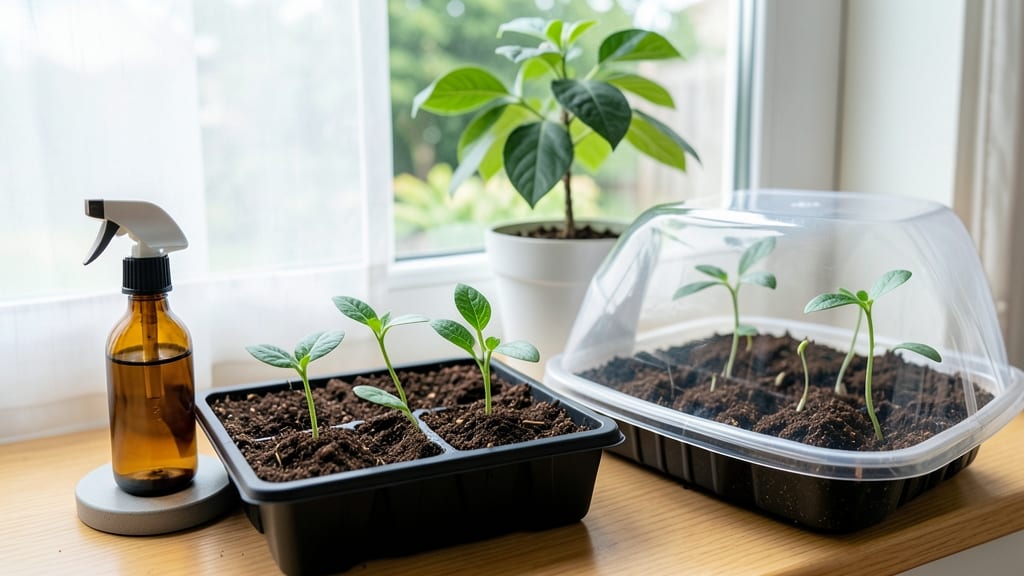
You can grow a persimmon tree from seed, but expect low success rates and unpredictable fruit quality. Seeds need 60-90 days of cold stratification before planting, and resulting trees may take over a decade to produce fruit that won't resemble the parent plant.
Persimmon seeds are notoriously finicky to germinate, with success rates often dipping below 50% even under ideal conditions. 🌱 The process mimics nature's timing—seeds need a winter chill period to break dormancy, which is why cold stratification is non-negotiable.
Once sprouted, seedlings grow slowly, requiring patience as they develop into mature trees capable of bearing fruit. Many gardeners opt for grafted varieties instead, since seed-grown trees frequently produce inferior fruit or none at all.
If you're committed to the seed method, start by collecting fully ripe fruit and extracting seeds immediately. Store them in moist peat moss or a damp paper towel in the fridge for the stratification period.
Afterward, plant in well-draining soil and keep the area consistently moist until germination occurs—typically within 4-8 weeks. Remember, this is a long-term project where instant gratification isn't part of the equation.
💡 In This Article
- Persimmon Seed Germination Process Explained
- Growing Persimmon Trees from Seed: Practical Steps and Expectations
Persimmon seed germination process explained
Persimmon seeds enter a natural dormancy state that mimics winter conditions, requiring what botanists call cold stratification to break. This process involves exposing seeds to temperatures between 35-45°F for 60-90 days—think of it as a forced winter in your fridge.
During this time, internal chemical changes occur: the seed's embryo produces enzymes that break down stored starches into sugars, providing energy for germination. Without this chill period, seeds may remain dormant indefinitely, even if planted in warm soil.
The stratification duration varies slightly between varieties.
Asian persimmons (like 'Fuyu') typically need the full 90-day period, while American persimmons (such as 'Meader') may germinate with just 60 days of cold treatment. 🌱 What's fascinating is how this mimics nature's timing—seeds dropped in autumn would naturally experience these cold temperatures before spring planting.
The key is maintaining consistent moisture during stratification (about 40-50% humidity) while preventing mold by using sterile mediums like damp peat moss or paper towels.
Once stratified, seeds should be planted in a well-draining potting mix at a depth of ½ inch, with the pointed end facing downward. The ideal germination temperature then shifts to 70-75°F, which is why many growers use a heat mat or move pots to a sunny windowsill.
Germination can take 4-8 weeks, but patience is crucial—some seeds may take up to 12 weeks to sprout. This variability explains why gardeners often report germination rates below 50%, even with perfect conditions.
The biggest challenge lies in genetic unpredictability. Persimmon seeds are highly heterozygous, meaning each seed carries a unique combination of traits from the parent tree. 🌳 While your seed might come from a sweet, astringency-free 'Fuyu' persimmon, the resulting tree could produce bitter, seedy fruit—or none at all.
This genetic roulette is why commercial growers rely on grafting rather than seeds: grafted trees inherit the exact characteristics of the parent plant, guaranteeing fruit quality and consistency.
Soil composition plays a secondary but critical role in early seedling survival. Persimmons thrive in slightly acidic soil (pH 5.5-6.5) with excellent drainage to prevent root rot. A mix of 60% garden soil, 30% compost, and 10% perlite creates ideal conditions.
Young seedlings are particularly vulnerable to damping-off disease, so avoid overwatering and ensure good air circulation around the container.
Here's what most gardeners overlook: the seed's outer coat contains natural inhibitors that delay germination. Scuffing the seed's surface with sandpaper (lightly!) before stratification can improve success rates by 10-20%. This mimics natural wear-and-tear from passing through an animal's digestive tract or freezing/thawing cycles. 💫 The trade-off?
You risk damaging the seed if you're too aggressive—think "light sanding," not "sanding down to bare wood."